Liz Smith on the Internet

Last week, Liz Smith, the New York Post's legendary 86-year-old gossip columnist, gave a pretty fascinating interview about her recent layoff to Lloyd Grove, who also happens to be a legendary erstwhile gossip columnist (he wrote for the Daily News.)
(Forgive me if any of the aforementioned info was unnecessary-- I never know how much of this semi-insidery media stuff is general knowledge, and how much shorthand I can use when talking about it. When I lived in New York it was pretty much impossible for me to go a day without buying the NYP or the NYDN, because how could I not? They only cost like 25 cents and were pretty fun to read, if only for the gossip columns and horoscopes.)
Anyway, both Smith and Grove were recently fired from their NYC gossip gigs, so you could tell in the interview they are kind of like old friends, sharing war stories and shaking their heads together about "the world nowadays."
Although a lot of things in the interview did not make sense to me-- who prefaces a $125,000 salary in journalism with the word "only"?-- I did kind of agree with a few of her sentiments. One in particular has kind of been echoing in my head for a few days:
--------
I don’t think [news websites] mean anything either, except they mean instant success for these very, very energetic and ambitious young people. And it’s perfectly fine, but I wouldn’t give any credence to most of the stuff I read. ... We’re going to have the Internet even when we don’t have things to eat. We’re going to still have it.
--------
My question is-- is that a good thing? She doesn't quite seem to think so, or at least she's still on the fence.
But some people, like those at, say, One Laptop Per Child, would argue having Internet access and information is more important than-- obviously not food or water-- but many, many other material things that previous generations may have seen as signs of success.
As for me, I'm honestly not sure if I think Liz Smith has a great, common-sense point of view, or if she's just missing the point.
The shallow rivers roar, the deep are still
The first time I read this poem was way back in the fall of 2001, when part of it appeared in a literature test I was taking. The test did not cite the poem's author, but the poem was so perfect that it haunted me for months after. Unfortunately, it was very obscure-- even though I'd remembered swaths of the poem verbatim, in those early days of online search engines it was impossible to find on the Internet.
I finally tracked it down during a trip to Harvard in the spring of 2002. I was visiting the campus, and figured that if a work of literature was anywhere, it would be in Harvard's library. I was right, and I can still remember the feeling of quiet victory I experienced while kneeling down over a musty old book in Harvard's stacks when I finally found the poem in print.
It's very romantic, but not in the traditional sense-- I think it speaks most for those of us who don't always wear our hearts on our sleeves, and sometimes find it impossible to express our real feelings at the right time. I think those kinds people are often the most sensitive and romantic of all.
To My Lady E.C. at her Going Out of England
by Sir John Suckling
I must confess, when I did part from you,
I could not force an artificial dew
Upon my cheeks,

Nor with a gilded phrase
Express how many hundred several ways
My heart was tortur'd,

Nor, with arms across,
In discontented garbs set forth my loss.

Such loud expressions many times do come
From lightest hearts; great griefs are always dumb.
The shallow rivers roar, the deep are still;
Numbers of painted words may show much skill, but little anguish;
And a cloudy face is oft put on, to serve both time and place.

The blazing wood may to the eye seem great,
But 'tis the fire rak'd up that has the heat,
And keeps it long.
True sorrow's like to wine:
That which is good doth never need a sign.

My eyes were channels far too small to be
Conveyers of such floods of misery.

And so pray think; or if you 'd entertain
A thought more charitable, suppose some strain
Of sad repentance had, not long before,
Quite emptied for my sins that wat'ry store.

So shall you him oblige that still will be
Your servant to his best ability.
Ladies' Choice
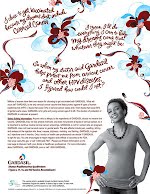
Turns out, I have less than two more years to receive the Gardasil vaccine-- it's officially recommended only for women and girls aged 9 to 26. Once you hit 27, it's next to impossible to get insurance to cover the three shots, which aren't cheap: Gardasil has a list price of $360, plus you have to pay the price your doctor charges for administering it. In fact, it's the most expensive vaccine ever to receive the FDA's recommendation.
Since my time is kind of starting to run out, I decided to do some homework today about cervical cancer and what Gardasil does. You guys: I was pretty surprised by what I found.
The first thing I looked for was the actual figures about cervical cancer itself. According to the most recent estimates from the National Cancer Institute, there were 11,070 women diagnosed with cervical cancer in the US in 2008, and 3,870 deaths attributed to the disease. Some perspective: 182,460 US women were diagnosed with breast cancer in 2008, with 40,480 deaths. In fact, cases of cervical cancer make up just 1.5% of all cancer diagnoses in American women every year, and 0.7% of cancer diagnoses in the US overall.
I was shocked that the incidence of cervical cancer is so relatively low, especially given the number of ads for Gardasil I've seen over the past two years and the number of friends I know who have gotten the vaccine. That said, I do realize that 11,070 cases is 11,070 cases too many, especially if it can be prevented. It's still a no-brainer to take a vaccine that could completely eliminate that risk, no matter how small, right?
But then I realized that many of us already take proven precautions against cervical cancer with yearly Pap tests. And, it seems if more women did the same, that already-small 11,070 figure could drop dramatically: According to the American Cancer Society, between 60% and 80% of American women with newly diagnosed cervical cancer hadn't had a Pap test in the past 5 years-- and many of them had never had a Pap test.
In light of all this, Gardasil's adoption in its short time on the market seems almost irrational. The CDC reported in October that a whopping 25% of all teenage girls in the US have received the Gardasil vaccine. Virginia now requires by law that girls complete a three-shot vaccination against HPV before they enter the sixth grade, and nearly every other state has had similar bills under discussion since Gardasil's debut.
It seems to me that Gardasil has had a disproportionately large adoption rate for a vaccine that seems poised to benefit such a relatively small potential audience. For me, the jury is still out on whether or not I'm going to take the vaccine-- but after the research I did today I feel more confused than ever.
Seriously-- am I missing something here? What's up with Gardasil?
Kate Hudson sounds like fun
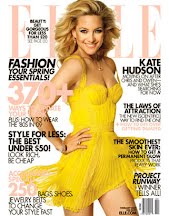
I know the whole growing-up-as-Hollywood-royalty-by-being-the-daughter-of-Goldie-Hawn-and-Kurt-Russell thing might add to her apparently awesomely blissful personality, but the latest cover story in Elle Magazine kind of made me like Kate Hudson. Which is saying a lot, because I've always just thought of her as that annoying "How to Lose a Guy in 10 Days" girl.
The article's tipping point for me:
"Let me give you an idea about Kate," [Kate Hudson's lifelong friend Jen] Meyer says. "You go spend a day with her, and you'll go into her house and she will be in a bikini, having just been lying out, walking around with the most perfect body you've ever seen in your life. She'll be saying to [her son] Ryder, 'Honey, we're going to go on a bike ride in just a few minutes; Mommy's just making you a banana souffle'-- no cookbooks out-- and, at the same time, go, 'Oh my God, Jen, you have to hear this,' and she'll go over to the piano and play a perfect song she just wrote like it's nothing. You go, 'Okay, that was amazing,' and she runs right back to the kitchen, gets the banana souffle out-- it's the greatest banana souffle you've ever had-- and she throws on her helmet and gets on the bike with Ryder."
Um, Kate Hudson, can we seriously be friends?

